On Thursday, some major comic news broke: Marvel announced it’s moving from its longtime offices in New York City to Burbank, California, to join Marvel Studios (the TV/movie side) and their corporate owner, Disney. Marvel plans to have the move complete by July 2027. Over 100 New York workers are being asked to relocate.
Among those moving will be Marvel’s new editor, Stephen Wacker. Wacker replaces C.B. Cebulski, who’s been editor since 2017, and will be taking over Marvel’s manga operations in Japan. Given the controversy involving Cebulski’s earlier work history, this hasn’t gone unnoticed by others (including plenty of snarky remarks on Bluesky).
This marks the end of a very long era for Marvel, as the House of Ideas has been based in New York since its founding in 1939. Marvel’s longtime competitor, DC Comics, also was based in New York since its founding, until it moved to Burbank in 2015 to join parent company Warner Bros. I suppose at least the two companies will once again be in the same town, though Los Angeles’s culture is very different from New York’s (see: the heavy reliance on cars, for starters).
I wrote about DC’s move back in the early days of the blog, but most of what I wrote also applies for Marvel. Like DC’s relationship with Warner Bros., Marvel as a comic publisher mainly exists to maintain and create new intellectual property for Disney to exploit as movies, TV shows, and merchandise, all of which are more lucrative. Thus, moving to California to be alongside its parent company makes business sense. The modern digital- and internet-based nature of comics publishing (especially with the pandemic) also means remote work is feasible, and being in an office less necessary—especially paying for expensive New York office space.
Hopefully, as Comics Beat noted, this move also gives Marvel a chance to modernize some of its operations, and shake off the remaining remnants of Ike Perlmutter’s penny-pinching reign. One area Marvel should focus on improving is its graphic novel/trade paperback offerings, one of many areas where Perlmutter cut corners.
New York vs the west coast in Marvel (and DC)
One big aspect about all this is that unlike DC, Marvel made New York a big part of the Marvel Universe’s identity. New York was chosen on purpose as the main setting for most of Marvel’s heroes. Not only because Marvel was headquartered there, but also for realism and to differentiate it from DC’s various fictional cities, such as Metropolis and Gotham City. That said, those two cities are mostly New York pastiches, and the real New York also exists in the DC Universe.
I also note that the west coast doesn’t seem to play as big a role in Marvel or DC’s universes—even the Midwest has a bigger role, at least in DC, as heroes like the Flash and Hawkman live there (in fictional Central City and Midway City respectively). That said, the Marvel Universe sometimes feel too New York-centric; it feels like aliens could conquer Indianapolis and start setting up statues of themselves in the state capitol building before the Avengers or Fantastic Four look west of the Hudson River long enough to notice. Never mind “joke” teams like the Milwaukee-based Great Lake Avengers—the very idea of Milwaukee (population 577,000) having a superhero team when it can… wait for the New York-based heroes to (eventually) show up.
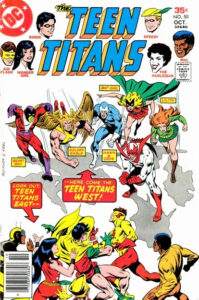
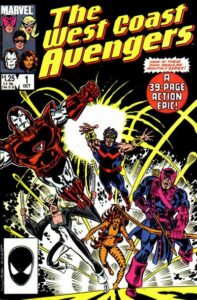
The west coast in Marvel and DC seems to come up mainly for the following plot-specific reasons: earthquakes; Las Vegas and its casinos; Hollywood; cowboys (in Western stories); nuclear testing (in 1950s/60s stories); and secondary “west coast” teams that’re usually shown to be the “farm league”/”inferior” versions of a main (often east coast-based) team—see the West Coast Avengers and Titans West. (In the 2000s animated series, the Titans are the ones based out west, with a “Titans East” secondary team.) Some exceptions exist, of course; Green Arrow spent a long stretch based in Seattle, plus Green Lantern Hal Jordan’s hometown of Coast City is explicitly in the Golden State. Still, it feels ironic that both major superhero publishers, especially Big Apple-loving Marvel, are now based in California.
I assume the heavy east coast focus of Marvel and DC is a remnant of Marvel and DC starting during the Depression, when Los Angeles was only the nation’s fifth-biggest city (after New York, Chicago, Philadelphia, and Detroit). By the time the modern Marvel Universe began in the early 60s, LA had become the US’s third-biggest city, after Chicago. (Today, Los Angeles is the second-biggest city in the country, with Chicago third.)
As for what major comic publishers remain in New York, the Hollywood Reporter claims none are left. Which isn’t true—Scholastic is still in New York, as the city’s still the center of the American publishing industry. And Scholastic’s children’s graphic novels easily outsell DC and Marvel combined outside of the direct market (i.e., comic book shops). If the metropolitan area counts, Archie Comics is located in nearby Westchester County, New York. (In Marvel stories, the X-Men’s school for mutants/team headquarters calls Westchester County home.)
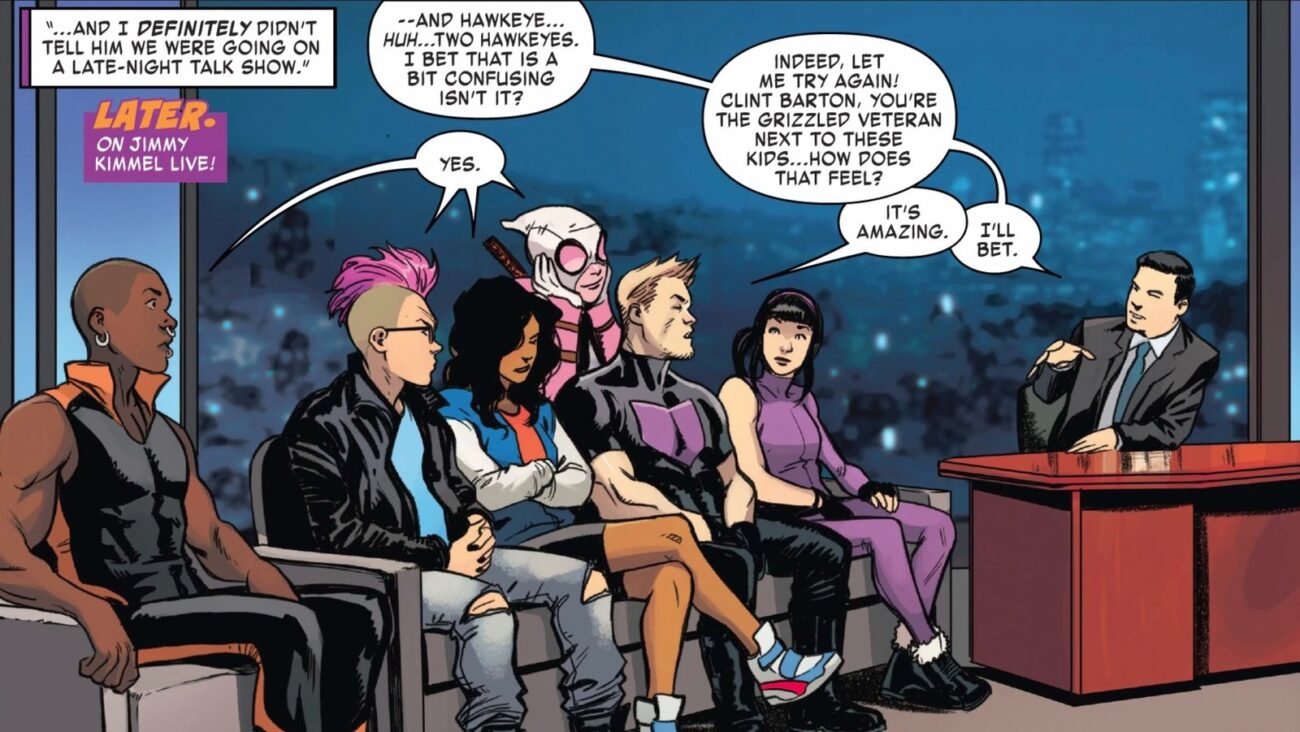
Image: The West Coast Avengers and Jimmy Kimmel. From “West Coast Avengers” (vol. 3) #4 (January 2019). Art by Stefano Caselli. (Marvel)
