
Today’s cartoon review is a look at Pac-Man in animation, mainly the 1980s Hanna-Barbera animated series. However, I’ll also mention the 2010s reboot “Pac-Man and the Ghostly Adventures.”
“Pac-Man” is the first cartoon based on a video game. The series debuted in 1982 on ABC, and ran for two seasons totaling 44 episodes.
Ronald Reagan and deregulation
Before delving into the cartoon, I should discuss why this show exists at all. Like many trends stemming from the 1980s, you can thank Ronald Reagan, president of the United States from 1981 to 1989. (Plus the people who voted for him twice.) To quote from my post about 1980s animation trends:
One of the biggest influences on 1980s TV animation was Ronald Reagan. As president, Reagan’s aggressive deregulatory stance upon taking office in 1981 also extended to his FCC. Animation World Network has an article covering Reagan’s influence.
Mark Fowler (Reagan’s FCC commissioner) felt that rules regulating advertising on children’s TV weren’t necessary, as the free market should be free to determine programming choices. Thus, it’s little surprise to anyone said market “determined” shows based on toy lines (and effectively being half-hour ads) were ideal.
The 1981-82 TV season, the first season under the Reagan-led FCC, didn’t see any reflection of these deregulatory rules. Its lineup still reflected what was in vogue in TV animation in the late 70s, aside from the debut of that season’s biggest hit, “The Smurfs” […] However, the debut of “Pac-Man” in 1982 was the start of the trend of shows based on toys and other product lines.
I should note that in the early 1980s, while video games were the hot new item, they were also seen as, well, a game/toy/fad—not a medium like movies, TV, or books; sorry, gamers. (The video game crash of 1983 certainly didn’t help video games’ image.)
Summary
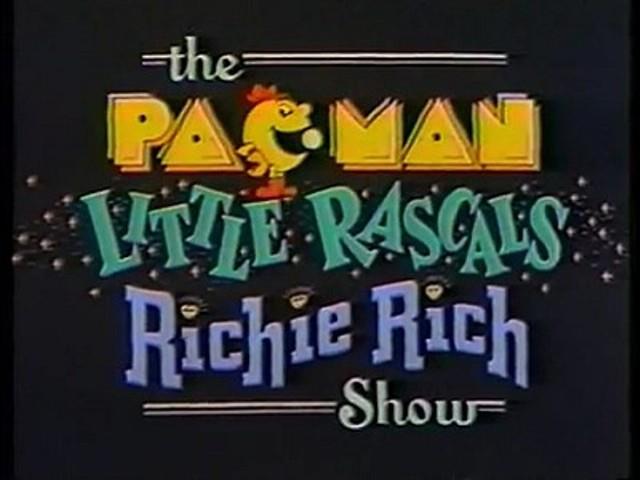
“Pac-Man” debuted on ABC in 1982, and originally ran over its two seasons as part of two anthology package shows:
- The Pac-Man/Little Rascals/Richie Rich Show (1982-1983): Ran for 90 minutes. The other two segments consist of “Richie Rich” (who aired on a previous package show, “The Richie Rich/Scooby-Doo Show,” from 1980 to 1982) and a cartoon based on the classic “Our Gang”/”Little Rascals” live-action theatrical shorts.
- The Pac-Man/Rubik the Amazing Cube Hour (1983-1984): The latter is an animated series based on the then-popular Rubik’s cube toy.
The series stars Pac-Man and his family, who all live in Pac-Land. Each episode usually sees Pac-Man defend Pac-Land against the ghosts from the original games, named “Ghost Monsters” here. (Apparently early promotional material sometimes called them “monsters,” so guessing Hanna-Barbera just combined both names?) The Ghost Monsters work for the series’ sole humanoid character, Mezmaron, a Darth Vader-esque figure who wants to find Pac-Land’s secret “Power Pellet forest,” the source of power pellets (the Pac-folks’ main source of food and energy). With said power pellets, Mezmaron plans to control and conquer Pac-Land. Occasional episodes also focus on Pac-Man’s daily antics with his family.
Like in the game, eating a power pellet provides a temporary power-up. This lets Pac-Man (or any Pac-person) chomp on the Ghost Monsters, reducing them to floating eyes. Also like in the game, the Ghost Monsters turn purple with fear over being chomped, as well as go back to their lair for new ghost outfits. In turn, the Ghost Monsters can also chomp Pac-Man and other Pac-people, draining their energy and reducing them to disheveled states. (The series sees the Ghost Monsters talk a lot about wanting to “chomp Pac-Man’s bones.”)
If it sounds familiar, the TV show basically treats power pellets like Popeye’s spinach. It probably helps Hanna-Barbera at the time also produced a Popeye animated series, which ran from 1978 to 1983.
Similar to “The Flintstones” and “The Jetsons” basing or naming everything after rocks/space, everything in Pac-Land is themed around or named after Pac-Man, including his iconic video game shape. For instance, “Pac-Hollywood” is the entertainment capital of Pac-Land; the Pac-President lives in the “Yellow House”; many expressions, terms, etc. are puns based on the word “pac” or “chomp” (occasionally “waka waka,” per the video game sound effect).
Cast

- Pac-Man. The main star, Pac-Man’s job is defending the secret location of the Power Pellet forest and protecting Pac-Land from the Ghost Monsters. Pac-Man is voiced by Marty Ingels.
- Ms. Pac-Man. Pac-Man’s wife, who goes by the name/nickname “Pepper” here. She’s voiced by Barbara Minkus.
- Pac-Baby. Pac-Man and Ms. Pac-Man’s toddler-aged son, who (like Popeye’s Swee’Pea) sometimes unintentionally gets into or causes trouble. Pac-Baby is voiced by Russi Taylor.
- Chomp-Chomp. Pac-Man’s pac-dog. Like Odie in “Garfield,” he’s not the sharpest tool in the shed, but loves his family and tries to help Pac-Man. Chomp-Chomp is voiced by Frank Welker.
- Sour Puss. Pac-Man’s pac-cat. Sour Puss, per his name, has a perpetual scowl on his face. He spends most of his time in a one-sided rivalry with Chomp-Chomp, constantly trying to pull tricks on the dog, all of which backfire. Sour Puss is voiced by Peter Cullen (yes, that Peter Cullen—Optimus Prime of “Transformers” fame).
- Super-Pac. A second season addition, Super-Pac is a bumbling, egotistical, and self-aggrandizing superhero loosely based on the “Super Pac-Man” game. Like in that game, Super-Pac can eat a “super power pellet,” allowing his chomping powers to go into overdrive (and haywire). Super-Pac is voiced by Lorenzo Music (of “Rhoda” and “Garfield” fame).
- PJ. Pac-Man’s teenage cousin, PJ thinks of himself as a cool guy who sometimes shows up to hang out with his “cuz.” Basically a loose pastiche of the Fonz from “Happy Days” (which Hanna-Barbera also produced an animated version of at the time); he’s also loosely based on the “Jr. Pac-Man” game. PJ is voiced by Darryl Hickman.
As for the villains:
- Clyde. The leader of the Ghost Monsters, Clyde’s perpetually cranky, aggressive, and bossy toward the others. In the video games, Clyde and Blinky’s roles and personalities are basically swapped; my guess, Hanna-Barbera thought Clyde was a more appropriate name for the leader of a group of tough guys, a la “Bonnie and Clyde.” Also, Hanna-Barbera’s late 60s cartoon “Wacky Races” features a character named Clyde, as the leader of 1920s mobsters the Ant Hill Mob. Clyde is voiced by Neil Ross.
- Blinky. The most cowardly of the Ghost Monsters. Blinky is voiced by Chuck McCann.
- Pinky. The “strong guy” of the Ghost Monsters. In the video games, Pinky is usually female. Despite the color pink being highly gendered as “female” by the 1980s, I suspect Hanna-Barbera also only wanted “one girl” for the Ghost Monsters (just as the heroes only have one female member, Ms. Pac-Man); since Sue was here, Pinky became male. As for why not just have two female members of the Ghost Monsters (who’d be somewhat gender-balanced), again, it’s the 1980s. Pinky is voiced by Chuck McCann.
- Inky. The ditzy Ghost Monster, though also useful for his pockets having whatever tool or item the Ghost Monsters need. Inky is voiced by Barry Gordon.
- Sue. The one female Ghost Monster, Sue originates from the “Ms. Pac-Man” game (where she replaces Clyde), but gains her trademark purple color with this animated series. Sue has more common sense than the other Ghost Monsters, though she’s still capable of bumbling. Sue is voiced by Susan Silo.
- Mezmaron. The human (or humanoid) leader of the Ghost Monsters, and overall main villain. Mezmaron usually sends the Ghost Monsters to carry out his orders, while he remains in his “Lava Lair” to monitor them. After the Ghost Monsters’ inevitable failure, Mezmaron will berate them like any stereotypical Saturday morning cartoon villain. Mezmaron is voiced by Allan Lurie.
Highlights
- The series’ most remembered episode is the Christmas special “Christmas Comes to Pac-Land” (the fact it has its own Wikipedia page indicates such). Over the years, the special’s seen airplay on outlets such as Boomerang and MeTV Toons. As the title indicates, it’s about how Pac-Land celebrates Christmas for the first time, as Pac-Man helps Santa while dealing with the Ghost Monsters.
- The Ghost Monsters’ chomping-related songs they occasionally sing to themselves, usually reworded versions of classical music/public domain songs. One such song is a variant of the “Toreador Song” from the opera “Carmen.” A stock music piece, true, but maybe the Ghost Monsters aren’t as dumb as they look?
- One episode, “Backpackin’ Packy,” sees Inky (when asked for a “bear suit” by Clyde) pull from his pocket a Chicago Bears football uniform by mistake. Not sure if this was intentional by the writers, but it makes sense the Ghost Monsters would be Bears fans—the team’s longtime rivals are the Green Bay *Pack*ers. Another episode, “The Super-Pac-Bowl,” even has the Ghost Monsters attack and kidnap the show’s stand-in for the Packers at Pac-Land’s Super Bowl game.
- The “Pacula” episode, which also serves as the series’ Halloween episode, sees the titular vampire created and sent by Mezmaron to attack Pac-Land, to force them to give up the Power Pellet forest’s location. Cue a Bela Lugosi style vampire saying “I want to chomp your bones.” Additionally, Pacula is one of the few original characters from this series to reappear in the 2010s “Pac-Man and the Ghostly Adventures” series (also in that reboot’s Halloween episode).
- In the “probably didn’t age well” category is the show’s Thanksgiving episode. Pac-Man’s ancestors as the Pilgrims and the Ghost Monsters’ ancestors as Native Americans; the Pilgrims mention leaving their homeland to live without “oppressive Ghost Monsters.” All of which probably raises questions about this world’s history? Pac-Baby also gets dressed up by his visiting “Grand-Pac” as a “real Pac-Indian” for the meal.
- The series left some influence on the Pac-Man franchise as a whole. The 1984 arcade game “Pac-Land” uses visual elements from the “Pac-Man” cartoon, including incorporating the theme song. Sue also keeps her purple color in subsequent games in which she appears.
Pac-Man and the Ghostly Adventures
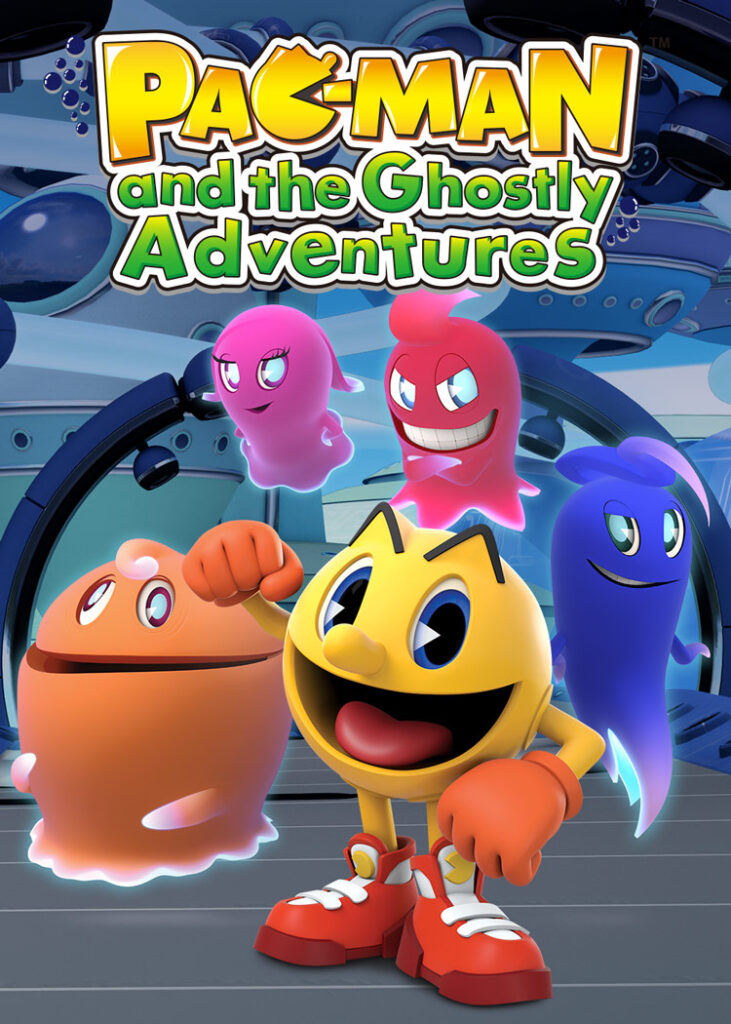
“Pac-Man and the Ghostly Adventures” is the second Pac-Man related TV cartoon. Running from 2013 to 2015 for two seasons totaling 52 episodes, the series aired on Disney XD, and unfortunately ended on a cliffhanger.
The CGI series features Pac-Man as a teenager defending Pac-World (not -Land) against Betrayus, the leader of the Netherworld’s ghosts who wants to take over Pac-World. Unlike the 1980s cartoon, Blinky, Inky, Pinky, and Clyde (no Sue here) are allies of Pac-Man. As Pac-Man’s a teenager here, there’s no Ms. Pac-Man, though a recurring subplot sees Pac-Man seeking his missing parents (who vaguely resemble the original Pac-Man and Ms. Pac-Man).
There also aren’t power pellets, as Pac-Man can chomp ghosts without them here; instead, eating special “power berries” (borrowing the fruit element from the original game) enhances Pac-Man’s chomping power, plus gives him various unique abilities. My guess for this change: to avoid any inference to drugs/steroids, similar to the modern handling of characters like Underdog or DC Comics’ Hourman?
Home video
The entire 1980s series, including its Christmas special, received a DVD release in 2012 on two separate season sets. For the related shows it originally aired alongside: “Richie Rich” has only seen a handful of episodes released to a single “Richie Rich/Scooby-Doo Show” set; no home video releases exist for “Rubik” or “The Little Rascals” (the latter’s caught up in complicated rights regarding that franchise).
A handful of episodes of “Pac-Man and the Ghostly Adventures” are available on several DVD sets.
The 1982 and 2013 “Pac-Man” series are available as of this writing in their entirety on Tubi, save for “Christmas Comes to Pac-Land” for some reason.
Opening credits
Here’s the season one and season two opening credits for “Pac-Man.” (For completists, here’s a link to the “Pac-Man/Little Rascals/Richie Rich Show” intro.)
Here’s the opening credits for “Pac-Man and the Ghostly Adventures.”
Conclusion
There’s not much else to say about this one—it’s a cartoon meant to promote the video game and related merchandise. However, it stands out as the first such show to exist, and left some mark on subsequent media/the Pac-Man franchise. The 1982 series also stands out considering the animators were adapting a video game with (at the time) no real backstory and was only two years old by that point.
Image: “Pac-Man” (Hanna-Barbera) and “Pac-Man and the Ghostly Adventures” (Bandai Namco).
Related Posts


