
Today’s comic review is a look at the long-running comic strip by Alison Bechdel, “Dykes to Watch Out For” (“DTWOF” for short). The comic strip ran from 1983 to 2008, and is one of the more prominent American LGBTQ-related comics.
Summary
The strip focuses on the lives of a cast of characters living in an unnamed mid-sized city. (To me, it resembles either Minneapolis or Buffalo, New York.) Real life political and current events of the time also intersect with the characters’ lives, as well as concerns ranging from relationships to health care to their careers. Despite the strip’s name, not everyone in the strip is non-heterosexual or a woman.
Cast
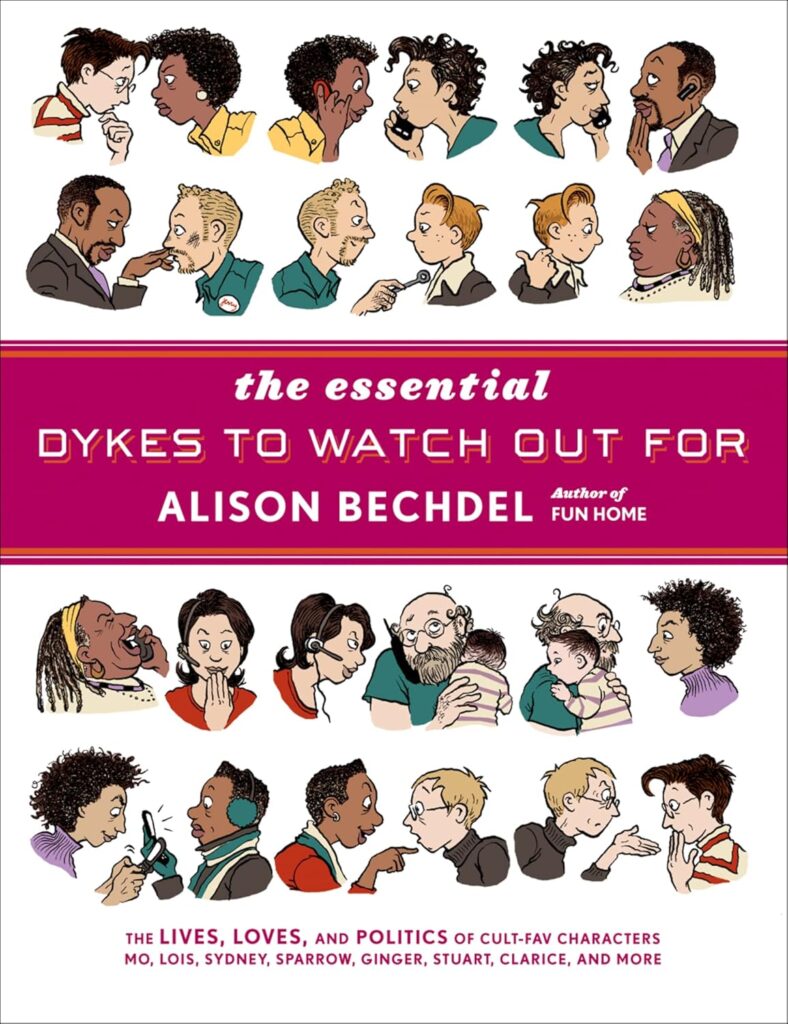
The main cast includes:
- Monica “Mo” Testa: The main character, a library school graduate; loosely based on Bechdel herself. Mo has a tendency to complain or worry about various things, mostly politics, which sometimes annoys even the more politically active members of the cast. Like other cartoon characters, Mo tends to wear a similar outfit in every strip (a striped sweater and jeans), which sometimes gets called out on by the other characters.
- Dr. Sydney Krukowski: A women’s studies professor and breast cancer survivor; Mo’s partner in latter strips. Unlike Mo, Sydney’s a bit more apathetic about politics (despite her job), not to mention a spendthrift.
- Clarice Clifford: An African American environmental lawyer.
- Toni Ortiz: A Latino accountant who eventually becomes Clarice’s partner. Over the strip’s run, the two have a commitment ceremony, civil union, and a marriage at city hall (not legally recognized by their state). Ironically, despite these multiple ceremonies, the two ended up splitting up. Toni and Clarice have a son, Rafael “Raffi” Clifford-Ortiz.
- Sparrow Pidgeon: A women’s shelter director.
- Stuart Goodman: Sparrow’s partner. Noted for being the most “hippie”-ish member of the cast (despite having competition from his own partner); one strip sees him sell their car (to protest peak oil) before informing Sparrow. Stuart and Sparrow have a daughter, Jiao Raizel (“J.R.”).
- Jezanna Ramsay: An African American woman; the owner of Madwimmin Books, a local bookstore that eventually goes defunct. Said store’s replaced by a “Velma’s Secret,” a play on real-life lingerie chain Victoria’s Secret and Velma Dinkley from “Scooby-Doo” (who gets officially acknowledged as liking girls in a 2022 direct-to-video movie.) Noted for being grumpy but well-meaning.
- Ginger Jordan: An African American English professor, whose politically conservative student Cynthia becomes a minor character. After years of being a roommate of Lois and Sparrow, Ginger buys a house with Samia, a Muslim chemist.
- Lois MacGiver: Former employee of Jezanna; a drag king and longtime roommate of Ginger and Sparrow. Dates Jasmine, who has a trans teenage daughter, Janis.
- Carlos: A gay man, and friend of Toni.
Note the cast’s relationships, supporting cast, etc. grew and changed as the series wore on.
The Bechdel Test
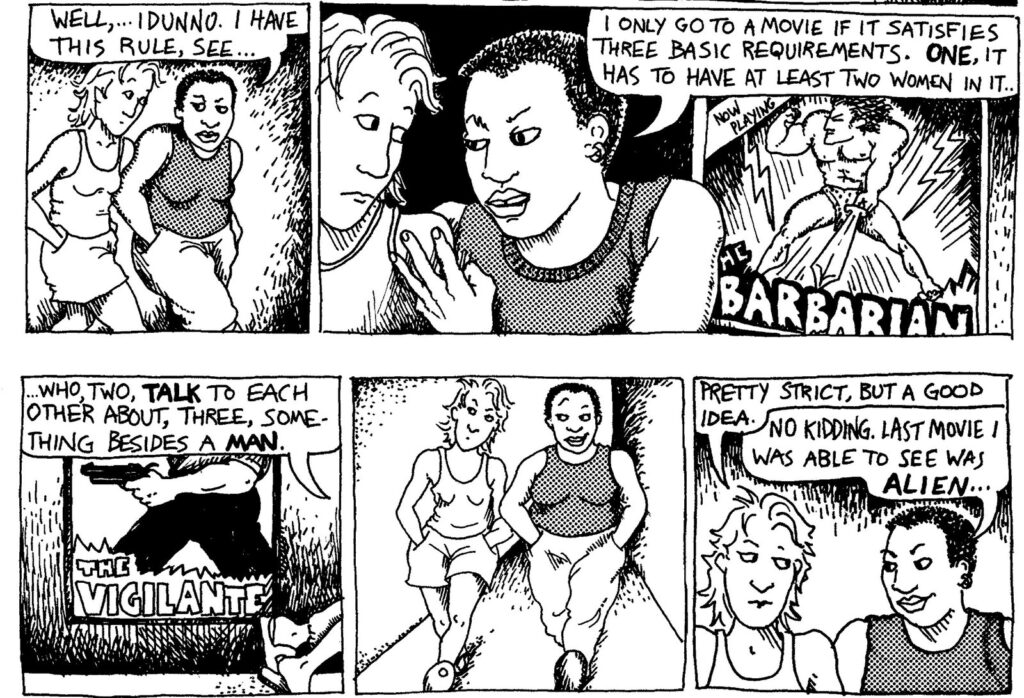
The most famous aspect of both “DTWOF” and Bechdel’s overall work, now dubbed “the Bechdel Test,” is ironically from an early strip before the main cast becomes fully realized. In a 1986 strip, two women (prototypes for Lois and Ginger) discuss watching movies. The Ginger-prototype states that she won’t see a film unless it meets three criteria:
- It has at least two women,
- They have a conversation with each other,
- About something other than a man.
The punchline is proto-Ginger notes she hasn’t been to a movie since “Alien,” a film that came out in 1979, or seven years before this strip was published.
The Bechdel Test, and the implications for mainstream media’s treatment of women, has gone on to become much discussed in various circles, including academic ones. The term’s even been mentioned by name in mainstream media.
Highlights
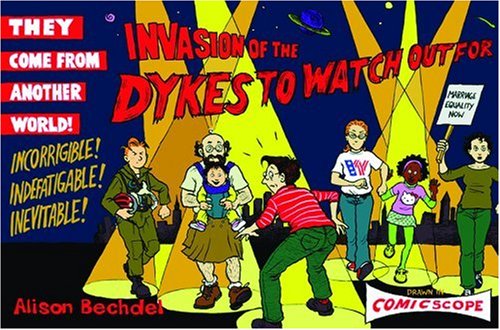
In a rarity for American comics, the cast of “Dykes to Watch Out For” aged roughly in real time. Thus, Raffi went from being a newborn to adolescence by the time the strip ended.
The strip uses plenty of parody names for major businesses. Madwimmin Books faces competition from “Bounders Books and Muzak” (Borders, which ironically went out of business in the US a few years after the strip’s conclusion) and “Bunns and Noodle” (Barnes and Noble). A home improvement chain’s named “Home Despot” (Home Depot). There’s even a few businesses named “Acme” (“Acme Florists,” “Acme Towing,” etc.), a la “Looney Tunes.”
A “reunion” strip of sorts was published in 2016, eight years after the final regular strip (the comic’s technically on “indefinite hiatus”). The strip focuses on the cast’s reaction to Trump’s election, as well as seeing a glimpse of them almost a decade later.
To my surprise, Alison Bechdel herself is referenced in, of all places, a Hallmark movie: the 2019 movie “Christmas in Evergreen: Tidings of Joy,” part of a series of films set in a fictional Christmas-obsessed quaint Vermont town. In the film, the town librarian mentions to an out-of-town writer (who’s doing research) a list of famous Vermont residents, including Alison Bechdel. As both the librarian and writer are women, I suppose the scene technically passes the Bechdel Test (though male Vermonters also get mentioned), even if the writer’s male love interest shows up a few moments later. I also note some recent Hallmark movies do focus on or star gay and lesbian characters. Hallmark also produces a line of LGBTQ-oriented greeting cards, so appeasing the MAGA crowd likely isn’t an option business-wise. (The MAGA crowd also have a “LGBTQ-free” Hallmark knockoff, Great American Family, despite its low ratings.)
Image: “Split-Level Dykes to Watch Out For.” Art by Alison Bechdel. (Firebrand Books.)
Related Posts


