“KPop Demon Hunters” is now Netflix’s most-watched movie ever. The Sony-animated movie is about a Korean pop music trio, “Huntrix,” who secretly protect Earth from invading demons. The animation’s definitely influenced by anime and Sony’s own “Spider-Man: Into the Spider-Verse.”
That said, the members of Huntrix aren’t the first cartoon musicians to fight evil. Below, I list some examples of musicians in cartoons who also double as heroes. I tried to pick at least one example per decade, though the past few decades have been a bit of a dry spell.
The Impossibles
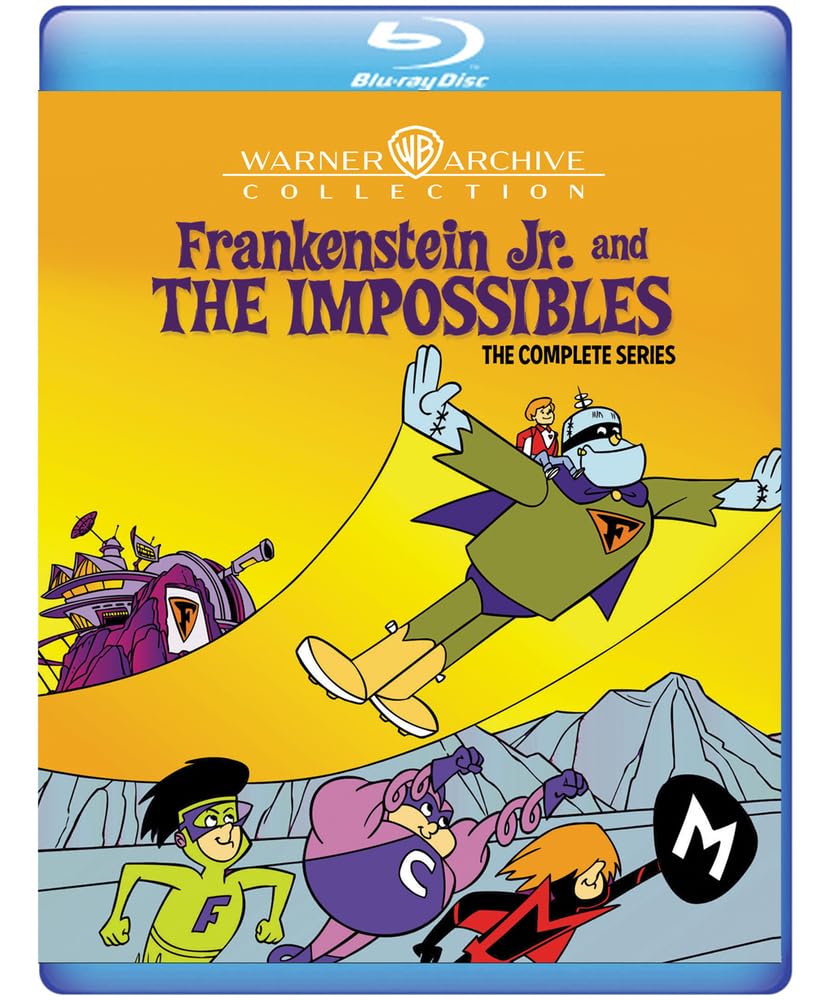
The Impossibles are the co-stars of the Hanna-Barbera cartoon “Frankenstein Jr. and the Impossibles.” Despite Frankie being the headliner, each episode had two shorts with the Impossibles and one with Frankie. The series aired from 1966 to 1967 on CBS.
The eponymous team are a trio of rock musicians (of the bubblegum rock variety) as a band also named the Impossibles. When trouble arises, they become their superhero alter-egos: Coil-Man (with springy, super-strong coils for limbs), Multi-Man (the ability to create instant temporary clones of himself), and Fluid-Man (can turn his body into any form of water).
The series came along as part of Hanna-Barbera’s transition away from their earlier slapstick cartoons (like Yogi Bear) to action shows like “Space Ghost.” It also likely exists as a way to cash in on the popularity of rock groups like the Beatles, as well as the superhero craze sparked by the “Batman” TV show. That said, the writing and art style still reflect the studio’s earlier comedic roots.
Interestingly, Wikipedia claims the heroes’ name in the show’s development phase was “The Incredibles.”
The Impossibles have largely gone unseen since the 60s, but appear from time to time in places such as DC Comics’ Hanna-Barbera-based action books from the 2010s. (They gain a fourth member in that incarnation, a woman named Cobalt Blue.) The original team also appeared in an issue of “Scooby-Doo Team-Up,” alongside Frankenstein Jr.
On video
The entire series is available on DVD and Blu-ray, the latter via the Warner Archive. It’s unavailable for streaming, though sometimes airs on MeTV Toons.
Theme song
Here’s the opening for the show.
https://youtu.be/X9daQ0EInf0?si=ORes8CA7GzE5DgmK
Josie and the Pussycats

“Josie and the Pussycats,” based on the Archie comic of the same name, aired from 1970 to 1972 on CBS. A spin-off, “Josie and the Pussycats in Outer Space,” aired for two more seasons on CBS from 1972 to 1974.
The cartoon, like the comic, is about a rock group, the Pussycats (Josie, Melody, and Valerie), plus roadie Alan, manager Alexander, and his scheming, snarky sister Alexandra. The comic focuses more on the daily lives of the band members, along with the concerts themselves. However, the TV show solely focuses on the band running across various villains (mad scientists, spies, etc.).
The TV show also changes a few characters’ personalities—Alexander’s TV version acts like a better-dressed Shaggy from “Scooby-Doo” (plus the same voice actor, Casey Kasem), while his comic self is a bit more like Archie’s egotistical Reggie Mantle. Alexandra and her cat Sebastian are in the series, but neither have the magic powers of their early comic versions.
The show’s also noted for being the first American TV cartoon to star an African American woman—Valerie. Valerie’s singing voice is Patrice Holloway, who also sings the famous theme song; her speaking voice is by Barbara Pariot.
The Pussycats continue to make appearances to this day in Archie’s comics, usually in backup stories. They also starred in a live-action 2001 movie; while it flopped at the box office, it eventually became a cult classic. The Pussycats would later appear in the CW series “Riverdale,” as well as the short-lived spin-off “Katy Keene.” Bleep, an alien pet from the “Outer Space” incarnation, appeared in “Jellystone!” (Since Hanna-Barbera owns Bleep as an original character, the “kooky guy”’s free to appear in “Jellystone!” without Josie and company.)
Like with “Scooby-Doo,” Hanna-Barbera produced several shows in the 1970s with a similar premise to “Josie,” as well as taking cues from Scooby. The “Josie” clones include:
- The Amazing Chan and the Chan Clan (1972). An adaptation of the Charlie Chan films; here, Chan has a large number of children, most of whom also play as a rock band.
- Butch Cassidy and the Sundance Kids (1973). A rock band work as secret agents and fight villains.
- Jabberjaw (1976). An undersea band in the future and their goofy great white shark drummer keep stumbling across various mad scientists, would-be conquerors, etc.
On video
“Josie and the Pussycats” and “Josie and the Pussycats in Outer Space” are available on DVD and Blu-ray. The original series is (as of this writing) streaming on Hulu, and sometimes also airs on MeTV Toons.
Theme song
Here’s the theme song for “Josie and the Pussycats.”
And yes, here’s its “Outer Space” version, too.
Kidd Video
“Kidd Video” is a DIC-animated series that ran for two seasons from 1984 to 1985 on NBC. The series sees a live-action teenage rock band abducted by the series’ villain, the Master Blaster, into his cartoon dimension dubbed “the Flipside.” The teens, with help from a fairy living there, spend their time fighting the villain and his minions, as well as trying to get back home.
The series couldn’t be more 1980s if it tried—even the fairy is wearing leg warmers! MTV is clearly also a heavy influence, reflecting its massive popularity at the time.
On video
There’s no modern home video release for the series. It’s also not on streaming anywhere, though some episodes are uploaded to YouTube. I assume music rights are to blame, or its current owner just isn’t interested in even a DVD release? Said owner apparently is Disney; “Kidd Video” is co-produced by Saban Entertainment (the “Power Rangers” people), which Disney bought in 2001.
Theme song
Here’s the theme song for the series.
Hammerman
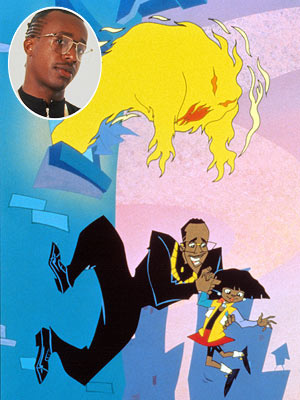
“Hammerman” is a DIC animated series that aired on ABC for a single season of 13 episodes, from 1991 to 1992. The series, based on then-popular rapper MC Hammer, features his animated alter-ego as a youth center worker who, via a pair of magic talking shoes, can transform into the superhero Hammerman. The shoes previously belonged to “Gramps,” an elderly mentor who was the 60s-era Motown-inspired hero “Soulman” (modeled after James Brown).
One episode featured a time-travel trip into the far-off, futuristic year of… 2012.
MC Hammer himself hosted the show in live-action segments, as well as singing the show’s theme song.
The show was definitely a product of its time. “Hammerman” came a year after NBC’s “Kid ‘n Play” cartoon, though that duo weren’t superheroes or fighting villains.
On video
“Hammerman” isn’t on any streaming service or modern video format. As such, the only way to watch it is episodes uploaded to YouTube (taped from their original broadcast). As for who currently owns the series, Wikipedia suggests it’s BMG (MC Hammer’s record label).
Theme song
Here’s the theme song.
Black Canary
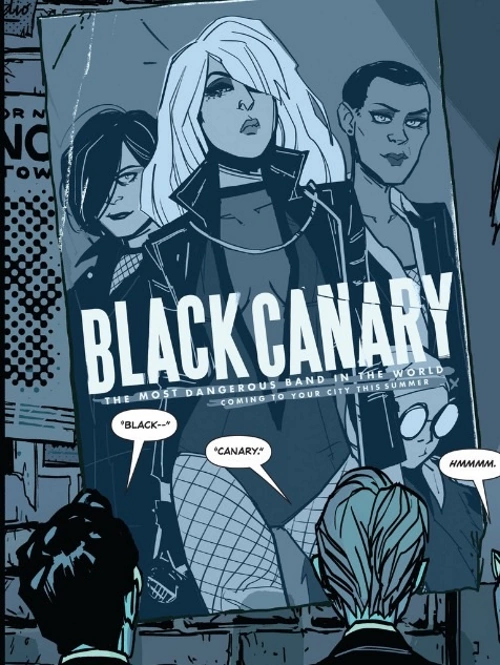
While Black Canary‘s been around as a character in various (often retconned) forms since her debut in “Flash Comics” #86 (August 1947), of interest here is her 2010s incarnation. Following the New 52 reboot in 2011, Dinah went through a number of changes. One change, introduced in 2015, is becoming the lead singer of her own rock band, named “Black Canary.” The band is billed as “The Most Dangerous Band in America,” with the expected hijinks (and property damage) ensuing. DC even released a real-life EP album to promote the band/storyline. I assume being in a band also gives Dinah a cooler and more modernized “day job” versus the one the character’s historically associated with, being a florist.
DC eventually undid most of the New 52-era changes, which (as far as I can tell) put Dinah back to her pre-2011 status quo. That said, the idea of her headlining a rock band has stuck around in spin-off media. Examples include the Webtoon strip “Wayne Family Adventures,” the young adult graphic novel “Black Canary: Ignite,” and the “DC Super Hero Girls” franchise.
Image: “Josie and the Pussycats.” (Archie Comics)
Related Posts